
There is a really great story in the Old Testament about the children of Israel coming back to Jerusalem after seventy years in captivity. They were taken captive in three groups and they came back in three groups.

The third group to return came back under the leadership of Nehemiah. He learned that the city wall was in shambles and it broke his heart. He appealed to the king and was allowed to return to rebuild the wall.

Read: Nehemiah 4:1-4; 6:8-9, 15; 12:27, 31, 38-39

This, to me, is one of the funniest stories in the Bible. Nehemiah and his men worked tirelessly to rebuild the wall. And from the very first moment, they had opposition. There were those who just did not want that wall to be rebuilt.

But Nehemiah would not be deterred. He developed a strategy to continue the work while his men protected themselves from invaders. At one point, the adversary dished out ridiculous words meant to scare them and make the builders feel stupid. In chapter 4, Tobiah taunted them saying that if even a fox walked on the top of the wall it would topple. Now a fox is a pretty small animal and the wall couldn’t be very sturdy if the presence of a fox caused it to topple.

What did Nehemiah do? He continued the work and when it was all finished, he dedicated the wall. As a part of the dedication ceremony he invited all his friends and neighbors to come and bring their friends and neighbors and they walked on top of the wall, all the way around the city, playing musical instruments and singing praises to God.

Now if that isn’t a funny twist, I don’t know what is. Every time I read it, I have to chuckle. He took their taunts and made it his victory. Not only did he finish the wall, he walked all over it!

What is your adversary saying? How will you respond when you accomplish what you are going after? Lean into the wisdom of God and know that your victory is on the way!


I am not much of an athlete. I am competitive, but not an athlete. My earliest experience with organized sports occurred in seventh and eighth grade track. My parents allowed me to participate in our track program and I actually performed very well. I ran dashes – that is what they were called at the time. The 50 yard dash and the 100 yard dash were my specialties and then I ran a leg of the 400 yard relay race.

The first day of a new week! A beautiful time to dedicate to the Lord. So wherever you find yourself today, set some time aside to see life in a new way and give thanks to him for all his goodness to you.

Read: Psalm 19:1-4

Thursday I went to the beach to scavenge shells with friends from North Carolina. We loved every minute of the looking and finding, surprised by all that rolled onto the beach at the North Jetty. Suddenly, I looked up to the sky. It was the most beautiful color of blue in every direction. Looking out into the gulf, the water was the loveliest green. In the horizon, the green of the gulf met the blue of the sky, stretching out for miles. It was absolutely stunning.

I realized that for the last hour I had my eyes on the sand and although I was finding treasures, I completely missed the beauty of the sea and sky.

Don’t forget to look around you today and see all the beauty of your surroundings. It might be people, landscape, or treasures, but God is showing up everywhere.

Photo by Chad Kirchoff on Pexels.com

John the Baptist, Jesus’ cousin, was sent to prepare the way for the Messiah. He baptized Jesus in the Jordan River and by all appearances, knew that he was the Messiah. But after his arrest, he seems to waver a bit.

Read: Matthew 11:1-6

Now, I’m sorry Jesus. But you did not answer the question. Or did he? What did we say the mission of Jesus was? What would mark him as the Messiah? Wasn’t it the things he did? Look at what he tells John the Baptist. The blind see, the lame walk, the lepers are cured, the deaf hear, the dead are raised to life, the Good News is preached to the poor.

Isaiah 61 coming to life right in front of their eyes! What more do they need to see?

Jesus last statement is worth hearing again. He says:

God blesses those who do not turn away because of me.

Matthew 11:6

Why does he say that? What does he mean? The answer might be found in Matthew 13:57 where it says, “And they were deeply offended and refused to believe in him.” This is referencing the people from Jesus’ hometown. They just couldn’t get past their home town boy doing miracles and proclaiming the coming of the Kingdom of Heaven. They turned away because of him.

Is your God-box small and confining? What if things happen that don’t fit inside there? Will you be offended because God acted outside of your idea of how God should act?

There is a really excellent short book entitled, “The Prisoner in the Third Cell” written by Gene Edwards. It is well worth the 45-60 minutes it will take to read. It is an excellent treatise on what happens when God doesn’t do what we think he should.

Does Jesus offend you? What has he done or not done that makes it hard for you to embrace him and the life he offers?

Even those who lived in the first century wanted to know who Jesus’ was. But Jesus’ answer often seemed vague and veiled.

Read: John 10:22-33

This encounter occurred near the end of Jesus’ life. The people are curious about his identity; they want to know if he is the Messiah.

Jesus says the proof is in the pudding. Well, maybe not in those words, but that is what he meant. It is here that he declares that he and the Father (God) are one. And for this, the people moved to stone him.

In essence, Jesus is saying that the works he did, the miraculous signs he performed, bringing the realities of heaven to earth are all signs that he is God.

Whatever you believe about Jesus, it must include that he is God in the flesh simply because that is what Jesus declared. As I meditate on that, I am filled with awe. Colossians 1:4 says through Christ, peace was restored between God and all of creation. That means me.

And that is Good News! What keeps you from embracing Jesus as God Incarnate? What must happen for you to be able to do that?

Read: Isaiah 61:1-3; Luke 4:16-19

Some passages, such as this one in Isaiah, are called Messianic because they point to and predict the coming Messiah. Isaiah wrote this hundreds of years before Jesus’ birth, but it pointed to a future time, when the Messiah would appear.

When Jesus was asked to speak in the synagogue, he chose this passage to announce his arrival as the long awaited Messiah.

What does this tell us about Jesus’ mission on earth? What did he really come to do? Here’s what I see…

First, he brings Good News! The good news is this…no longer will you be subject to the authority of the evil one. His reign is over and the kingdom of God is here. It is the time of the Lord’s favor.

Secondly, he comforts the brokenhearted. Sin damages the most tender part of who we are – our hearts. Not our physical hearts that pump blood, but the center of our emotions and mental wellness.

He releases the captives and sets prisoners free. We are free from sickness, oppression, slavery to sin and fear of death are a mark of his presence.

What part of his mission is absent from your life right now? He isn’t a great teacher, or a great prophet – he is the Son of God. God incarnate. The exact representation of God. And when we join his family, we are a child with full rights. So, go ahead. Tell him what you need. And then watch him move mountains!

“Who do you say I am?” This is the question we are examining this week. Jesus has been asking it for a long time.

Read: Mark 8:27-33

This is the only time Jesus’ asks that question aloud. He was with his disciples walking to the villages near Caesarea Philippi. I imagine as they walk they talk about their experiences. A deaf man hears, a blind man sees, the 4000 were fed, the Pharisees confront Jesus. They may have asked Jesus about these events but at some point, Jesus turns to them and says, “Who do people say I am?”

Notice he didn’t ask them outright “who do you think I am?” He begins softly, allowing them to process it a bit. The disciples replied that some said he was John the Baptist (a prophet, teacher), others said Elijah (prophet) and others said one of the other prophets.

And then Jesus asked what he really wanted to know and what he needed them to say aloud: “But who do you say I am?”

Peter boldly proclaims: You are the Messiah!

They were getting it! Jesus planned to leave his mission in the hands of twelve men. They needed to be sure of his identity.

Just moments later, Jesus tells them what is coming (his trial, death and resurrection), and Peter, emboldened by his last right answer, speaks up again. This time it is to pull Jesus back into line. He was astute enough to recognize that Jesus was the Messiah, but a suffering Messiah didn’t fit into his paradigm.

Just as Jesus had accepted the proclamation of truth from Peter’s mouth, he sternly reprimanded Peter for his misguided attempt to define “Messiah” in human terms.

I am challenged by this because I do the same thing. I acknowledge Jesus as God, the Messiah, the Anointed One. But when he moves outside of my Messiah box, I try to reign him in, put him where I am comfortable.

Jesus didn’t come to make me comfortable. He came to set me free. Paul says it like this in Galatians 5:1:

It is for freedom that Christ has set us free.

Galatians 5:1 NIV

Why did Jesus set me free? So that I could be free! Seems redundant, but that’s what it says.

So who do you say Jesus is? Does he make you uncomfortable? What will you do about that? Have you experienced the freedom he came to give you? Are you staying that way?

The first time I encountered the need to respond to Jesus was in the summer of 1971. I was at a family reunion with my parents and younger sister in Colorado. Maybe there were other siblings there too – I don’t remember.

Read: John 1:10-12; 1 John 2:22-23; 1 John 3:23-24; I John 4:2

I like happy messages. Words that convey I am doing a good job, not falling short. Criticism has historically been difficult for me because I want to get it right. If I didn’t get it right, someone must be disappointed with me.

Through various avenues the last few weeks, I keep hearing the same question, just worded a bit differently each time. But basically, it sounds like this: What are you doing with Jesus? C.S. Lewis said it like this:

I taught Christian History for several years. The element of early history that stands out to me is the way people came to be followers of Jesus after his death and resurrection. There was something so compelling about the way these people lived – the ones who called on the name of Jesus – that it required a response. People wanted to join them, even when they knew that decision may bring persecution, separation and sometimes death.

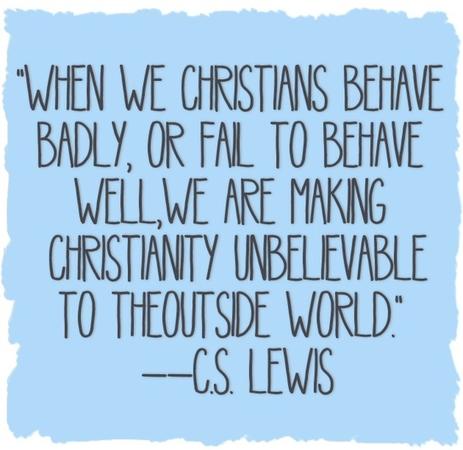
So, what are you doing with Jesus? Does the way you live compel people to make a decision about Jesus? Does it create a hunger in people for something more? Who do you say Jesus is?

This week while studying for the Daily Reads, I listened to a song by Bethel Music, sung by Kristene DiMarco. It is entitled “Take Courage.” It summarizes how I often feel…there seems to be a lot of waiting. But it is in the waiting that I often experience God most deeply.

I pray it will bless you as well. You can listen to it here. May you be at peace as you wait on your triumph, to experience God’s unfailing movement in your life.